
Drawing Practice Exercises for New Artists
Drawing is a wonderful skill that allows people to express their ideas, creativity, and imagination. Many beginners think that good artists are born with special talent, but in reality, drawing is a skill that improves through regular practice. Just like athletes train their bodies and musicians practice their instruments, artists must train their eyes and hands. Drawing exercises help beginners develop important skills such as observation, hand control, shading, perspective, and creativity. With patience and consistent effort, anyone can become a better artist.
One of the most important exercises for new artists is practicing straight lines. Although drawing a straight line may seem simple, it helps improve hand control and confidence. Beginners should fill pages with horizontal, vertical, and diagonal lines without using a ruler. This exercise strengthens muscle memory and helps artists create cleaner sketches. Another useful exercise is drawing basic shapes such as circles, squares, rectangles, triangles, and ovals. Almost every object in the world can be broken down into simple shapes. For example, a bird can start with circles and ovals, while a house can be created using rectangles and triangles. Practicing these shapes regularly helps artists understand proportions and object construction.
Shape construction is another valuable exercise for beginners. Instead of trying to draw a complex object all at once, artists can build it using simple shapes. A tree can be created using a rectangle for the trunk and ovals for the leaves. A car can be made from rectangles and circles. This method makes drawing easier and helps artists understand how objects are formed. Contour drawing is also an excellent exercise. In contour drawing, artists focus on drawing the outer edges of an object while carefully observing its shape. This exercise improves observation skills and teaches artists to see objects more accurately.
Blind contour drawing is a fun variation of contour drawing. In this exercise, artists look only at the object they are drawing and do not look at their paper. Although the results may appear funny, this method trains the eyes to observe details more carefully and improves hand-eye coordination. Gesture drawing is another useful practice exercise. It involves making quick sketches of people, animals, or objects in a short amount of time, usually one or two minutes. Gesture drawing helps artists capture movement and action rather than focusing on details. It improves drawing speed, confidence, and understanding of body posture.
Drawing everyday objects is one of the best ways for beginners to improve. Simple items such as cups, books, bottles, fruits, shoes, and mobile phones provide excellent practice. By carefully observing and drawing these objects, artists learn about proportions, shapes, and perspective. Observation is one of the most important skills in drawing, and sketching real objects helps develop this ability. New artists should carry a sketchbook and draw objects they see around them whenever possible.
Shading practice is another essential exercise for beginners. Shading adds depth, dimension, and realism to drawings. Artists can start by creating value scales that gradually change from light to dark. Practicing smooth transitions between different shades helps artists understand light and shadow. Once comfortable with basic shading, artists can apply it to simple objects such as spheres, cubes, and cylinders. Understanding how light falls on an object is important for creating realistic artwork.
Hatching and cross-hatching are useful shading techniques that every beginner should learn. Hatching uses parallel lines to create shadows, while cross-hatching uses intersecting lines to produce darker tones. These techniques improve line control and help artists create texture and depth. Many illustrators and comic artists use hatching techniques in their artwork. Practicing these methods regularly can significantly improve drawing quality.
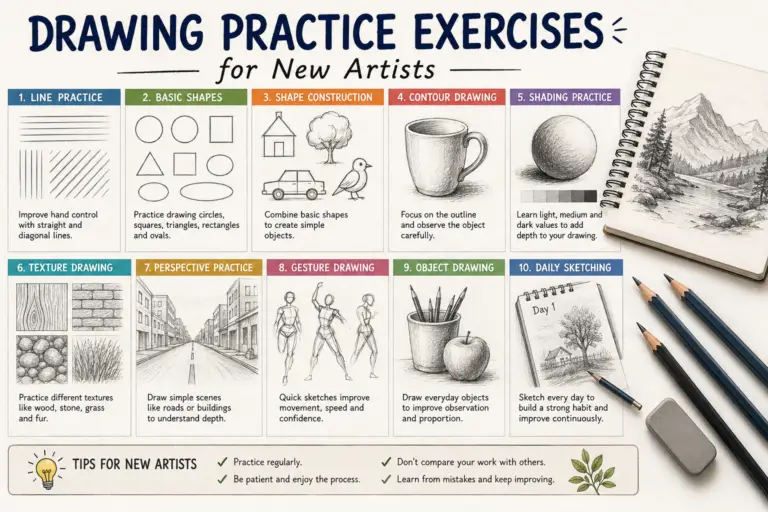
Texture drawing is another valuable exercise for new artists. Every surface has a unique texture, and learning to draw these textures makes artwork more realistic. Artists can practice drawing the texture of wood, stone, brick, grass, leaves, fur, and fabric. Carefully studying real objects helps artists understand how different surfaces look and feel. Texture practice improves observation skills and teaches artists how to add detail to their drawings.
Perspective drawing is important for creating the illusion of depth on a flat surface. Beginners can start with simple one-point perspective exercises such as drawing roads, railway tracks, hallways, or buildings that appear to move into the distance. Perspective helps artists create realistic landscapes, city scenes, and architectural drawings. Although perspective may seem difficult at first, regular practice makes it easier to understand.
Drawing boxes from different angles is another highly effective exercise. Boxes help artists understand three-dimensional forms and spatial relationships. Many professional artists recommend box drawing because it strengthens perspective skills and improves object construction. Once artists become comfortable drawing boxes, they can use similar techniques to draw vehicles, furniture, buildings, and other complex objects.
Negative space drawing is a unique exercise that teaches artists to focus on the empty areas around an object rather than the object itself. This method helps improve observation and makes it easier to identify correct proportions. Many beginners find that negative space drawing reduces mistakes and helps them see shapes more accurately. It is a simple but powerful way to improve drawing skills.
Copying drawings from experienced artists can also be a useful learning exercise. By studying how skilled artists use lines, shading, and composition, beginners can learn valuable techniques. However, copying should be used as a learning tool rather than a replacement for original work. Artists should analyze what they are drawing and try to understand the techniques behind it.
Memory drawing is another excellent exercise for developing artistic skills. In this exercise, artists observe an object for a short period and then attempt to draw it from memory. This strengthens visual memory, observation, and imagination. Over time, memory drawing helps artists become more confident when creating artwork without references.
Practicing facial features such as eyes, noses, lips, and ears is very important for artists interested in portrait drawing. Human faces are complex and require careful observation. Beginners should focus on one feature at a time before attempting full portraits. Similarly, drawing animals helps artists understand different body structures and forms. Starting with simple animals such as birds, cats, dogs, and rabbits can build confidence and improve observation skills.
Nature sketching provides endless opportunities for practice. Trees, flowers, leaves, mountains, and clouds offer a variety of shapes, textures, and patterns. Drawing natural subjects helps artists improve observation and creativity while also providing relaxation and enjoyment. Many artists enjoy sketching outdoors because it allows them to study real-world subjects directly.
Timed sketch challenges are another effective way to improve drawing skills. Artists can set a timer and attempt to draw a subject within one, two, or five minutes. These challenges improve speed, reduce fear of mistakes, and encourage artists to focus on the most important details. Quick sketches also help develop confidence and prevent overthinking.
Perhaps the most important exercise for any new artist is maintaining a daily sketchbook. A sketchbook serves as a personal space for practice, experimentation, and learning. Artists can draw objects, people, animals, landscapes, or ideas from their imagination. Even spending fifteen to twenty minutes each day drawing can lead to noticeable improvement over time. Consistency is far more important than occasional long practice sessions.
Many beginners make mistakes such as expecting perfection, comparing themselves to professional artists, or becoming discouraged by slow progress. It is important to remember that every artist improves through practice and experience. Mistakes are a natural part of learning and should be viewed as opportunities for growth. Patience, persistence, and a positive attitude are essential qualities for artistic development.
In conclusion, drawing practice exercises play a vital role in helping new artists build strong foundations. Exercises such as line practice, shape drawing, contour drawing, gesture sketches, shading, perspective studies, texture work, observation drawing, and daily sketching improve important artistic skills. Regular practice helps artists gain confidence, develop creativity, and improve their understanding of form and structure. With dedication and consistent effort, any beginner can become a skilled artist and enjoy the rewarding journey of drawing.