
How to Start Drawing Without Expensive Materials | Beginner’s Guide to Drawing on a Budget
Many people dream of learning drawing, but they often stop before even beginning because they believe drawing is an expensive hobby. They think they need costly sketchbooks, branded pencils, expensive colors, drawing tablets, or professional art kits before they can create good art. This idea discourages many students, beginners, and creative people who actually have talent and interest. The truth is that drawing does not depend on expensive materials. Drawing mainly depends on practice, observation, patience, and creativity. Many great artists started their journey with simple pencils, old notebooks, newspaper paper, or cheap pens. Even today, thousands of talented artists improve their skills using very basic materials. If you truly want to learn drawing, you can begin immediately with the things already available in your home. Expensive materials may help later, but they are never necessary for starting.
The first thing a beginner should understand is that drawing is a skill, not a product of costly tools. A beginner with a thousand-rupee sketchbook may still struggle to draw basic shapes, while another person using a simple school notebook may create beautiful sketches through practice. Just like a good writer does not need an expensive pen to write meaningful stories, a good artist does not need costly materials to learn drawing. The most important thing is consistency. Drawing daily for twenty minutes with simple tools is far better than buying expensive supplies and practicing only once a week. Many beginners waste money on art products and then feel afraid to use them because they do not want to spoil expensive paper. Cheap materials remove this fear and allow freedom to experiment.
One of the easiest ways to start drawing without spending money is by using ordinary pencils available at home. Most households already have pencils used for school or office work. Even a simple HB pencil is enough to begin sketching. Beginners often think they need a full set of professional graphite pencils like 2B, 4B, 6B, and 8B. While these pencils are useful, they are not compulsory in the beginning. A normal pencil can still create dark and light shades depending on hand pressure. By pressing lightly, soft shades appear, and by pressing harder, darker tones can be created. This helps beginners understand shading techniques naturally without purchasing multiple tools.
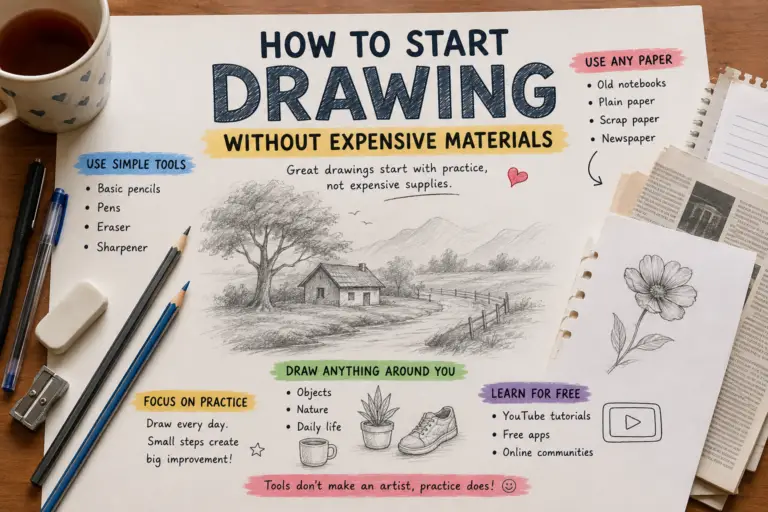
Paper is another thing that worries beginners. Many people think only professional sketchbooks are suitable for drawing. In reality, beginners can practice on almost any paper. Old notebooks, unused school pages, printer paper, newspapers, or the blank side of printed sheets can all be used for practice. Since beginners mainly need repetition and experimentation, expensive sketchbooks are unnecessary in the early stage. Drawing many rough sketches on cheap paper improves confidence faster than drawing only one careful sketch on costly paper. Some artists even recommend using low-cost paper initially because it teaches artists to focus more on skills rather than perfection.
Another useful method is using pens instead of pencils. Simple blue or black pens available at home can create wonderful drawings. Pen drawing improves confidence because mistakes cannot be erased easily. This teaches beginners to think carefully before drawing lines. Pen sketches can look beautiful even without shading. Many artists create detailed portraits and scenery using only a basic ball pen. Students who cannot afford art supplies can still improve greatly using ordinary pens and school notebooks. The important thing is regular practice, not expensive equipment.
Many beginners also believe that colors are necessary for good art. However, black-and-white sketches are one of the best ways to learn drawing fundamentals. Learning shapes, outlines, shading, textures, and proportions is more important than using colors in the beginning. A beginner who learns pencil sketching properly will understand coloring more easily later. Therefore, there is no need to buy expensive watercolor sets, acrylic paints, or markers immediately. Simple pencil sketches can look extremely beautiful and realistic when basic techniques are mastered.
Observation is one of the most powerful tools for drawing, and it costs nothing. A beginner can practice drawing objects available at home such as cups, bottles, books, shoes, plants, or fruits. These simple objects help artists understand shapes, light, shadows, and proportions. Instead of searching for expensive drawing classes or complicated subjects, beginners should start with everyday objects. Drawing from real life improves artistic skills faster than copying random internet images continuously. Even sitting near a window and sketching a tree or street view can become valuable practice.
The internet has also made learning drawing much easier and cheaper. Today, thousands of free tutorials are available online. Platforms like YouTube contain step-by-step lessons for beginners on sketching, shading, anatomy, cartoon drawing, landscapes, and realistic art. Beginners can learn almost every drawing technique without paying for expensive coaching classes. Many talented artists share their knowledge freely because they want to help new learners. A smartphone with internet access can become a complete art school if used properly. Free online learning has removed one of the biggest barriers for beginners.
Another important thing beginners should avoid is comparing themselves with professional artists. Social media often shows perfect drawings made with expensive materials, which can make beginners feel discouraged. However, people usually post their best work online after years of practice. Beginners should remember that every skilled artist once struggled with basic shapes and simple lines. Improvement happens slowly through practice. Even simple daily exercises like drawing circles, straight lines, cubes, or faces help build strong fundamentals over time.
Creativity is far more important than expensive supplies. Some artists create amazing art using charcoal from burnt wood, chalk pieces, coffee stains, or even fingers instead of brushes. This shows that artistic thinking matters more than tools. A creative mind can use simple materials in interesting ways. Beginners should experiment freely instead of worrying about perfection. Trying different textures, line styles, or shading methods develops confidence and originality.
One common mistake beginners make is waiting for the “perfect time” to start drawing. They believe they will begin once they buy a professional art kit. Unfortunately, this mindset delays learning. The best way to improve is to start immediately with available materials. Even rough sketches done today are more useful than expensive supplies bought tomorrow. Art grows through action, not preparation alone. Every drawing teaches something new, even if the result looks imperfect.
Drawing can also become a relaxing and stress-relieving activity. Many students and working people use sketching to reduce anxiety and improve concentration. Expensive tools are not required for enjoying this benefit. Sitting quietly with a pencil and paper for thirty minutes can calm the mind and improve creativity. Drawing allows people to express emotions, ideas, and imagination freely. This emotional connection with art matters more than using branded materials.
Beginners should also understand that professional artists themselves often use simple tools for practice. Even experienced artists carry small notebooks and basic pencils for quick sketches. They focus more on ideas and observation rather than expensive products. Many famous artworks in history were created with limited materials. Great art has never depended only on costly equipment. Talent grows through dedication, patience, and regular effort.
A good strategy for beginners is starting with a small daily routine. Drawing one object every day can create huge improvement within a few months. For example, one day a beginner can draw a leaf, another day a shoe, and another day a cup or hand. Small exercises slowly strengthen observation skills and hand control. Instead of trying extremely difficult drawings immediately, beginners should focus on steady progress. Improvement becomes visible naturally with time.
Another affordable option is digital drawing using free mobile apps. Many free drawing applications are available for smartphones and tablets. These apps allow beginners to practice sketching without buying paper repeatedly. Basic digital tools like brushes, erasers, and layers help learners experiment easily. While professional digital tablets can be expensive, beginners can still explore digital art using free apps and simple devices already available at home.
It is also important to learn that mistakes are part of the learning process. Beginners often become upset when drawings do not look realistic. However, every mistake teaches valuable lessons about proportion, shading, and structure. Artists improve by correcting errors slowly. Using cheap materials actually helps beginners make mistakes more comfortably because they do not fear wasting money. This freedom encourages experimentation and faster learning.
Support from family and friends can also help beginners stay motivated. Sometimes people stop drawing because others criticize their early work. However, every artist starts as a beginner. Encouragement and regular practice matter much more than instant perfection. Beginners should keep their old drawings safely because comparing them after a few months shows visible improvement. This boosts confidence and motivation.
Another useful idea is joining free online drawing communities. Many beginner artists share sketches on social media groups or art forums. Seeing the progress of other learners creates motivation and inspiration. Artists can exchange ideas, tips, and feedback without spending money. Learning together often makes the process more enjoyable and less stressful.
As skills improve, beginners can slowly buy better materials if needed. There is no need to purchase everything at once. A learner may first buy a small sketchbook, then a few shading pencils later, and eventually other tools according to interest. Gradual improvement in materials is more practical and affordable. Beginners should first discover which type of art they enjoy most before investing heavily. Some people may love pencil sketching, while others may prefer cartoons, landscapes, or digital art.
Drawing is not about having the richest art collection. It is about expressing creativity through lines, shapes, and imagination. Many people with expensive materials never practice consistently, while others with ordinary pencils become highly skilled artists through dedication. The journey of art begins with simple steps. What matters most is the willingness to learn and continue improving every day.
In conclusion, starting drawing without expensive materials is completely possible and practical. Simple pencils, ordinary paper, and regular practice are enough for beginners to build strong artistic skills. Observation, creativity, patience, and consistency matter much more than branded art supplies. Free online tutorials, household objects, and daily sketching can help anyone improve without spending much money. Beginners should stop waiting for perfect tools and start creating with whatever they already have. Every great artist once began with small steps and simple materials. The real power of drawing lies not in expensive equipment but in the imagination and dedication of the artist.