
How to Train Your Eye to Draw What You See
Training your eye to draw what you see is one of the most essential skills an artist can develop. Contrary to what many people believe, drawing is not simply about moving a pencil with precision; it’s about learning to observe with depth and accuracy. Most beginners look at objects symbolically and draw what they think something looks like—a generic eye, a typical nose, a simple tree. Skilled artists, however, learn to override these mental symbols and instead observe the real shapes, angles, proportions, and values that exist before them. This ability to truly see is far more important than natural talent, and it’s a skill anyone can build with consistent practice.
The first step in training your eye is understanding the difference between looking and seeing. When you look at an object, your mind tends to simplify it into familiar ideas. When you truly see, you break that object down into its actual visual components. This shift from symbolic thinking to direct observation is crucial. For example, when drawing an eye, instead of thinking about an almond shape with a circle in the middle, an artist notices subtle curves, asymmetry, shadows, the tilt of the eyelids, and how light reflects on the surface. Asking questions while observing—such as whether a line is really straight, where a shape begins and ends, or whether the angle is steeper than expected—helps you train your eye to notice what is actually there rather than what your brain assumes.
Learning to see in shapes instead of objects is another essential skill. When you focus on the shape of what you’re drawing rather than the object itself, your accuracy improves dramatically. Objects can be complex and overwhelming, but shapes are manageable. A mouth becomes a set of angled shapes and shadow patterns; a shoe becomes a series of curves, wedges, and negative spaces. When you detach the object from its identity, your drawings become more realistic because they’re based on observation instead of assumption. This mindset is at the core of classical drawing training and remains one of the most powerful techniques for improving your accuracy.
Negative space—the empty space around or between objects—also plays a major role in training your eye. Many artists find it easier to draw the shape of the space around an object than the object itself because negative shapes don’t trigger symbolic thinking. For example, when drawing a chair, the space between the legs often holds its shape more predictably than the legs themselves. Focusing on these empty areas naturally sharpens your sense of proportion and alignment without forcing you to think too hard about the object. Over time, this approach helps you see more accurately in any drawing situation.
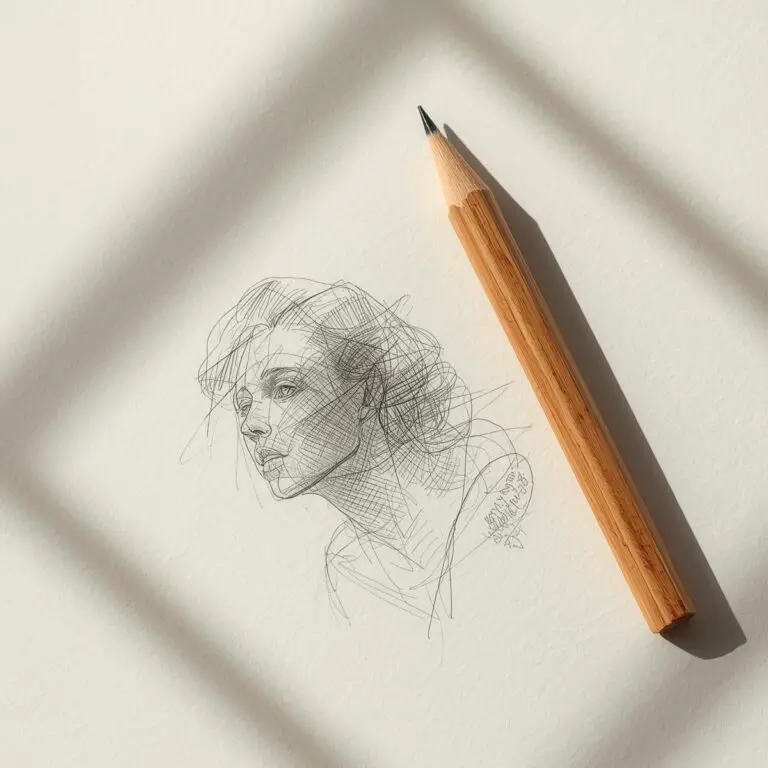
Another crucial component of training your eye is learning to measure visually. Professional artists constantly compare proportions and angles, whether they’re drawing from life or from a photo. This doesn’t require a ruler; it simply means using your eye to estimate relationships such as how wide something is compared to its height, how much an angle tilts, or how large one shape is relative to another. Many beginners tend to flatten angles or distort proportions without realizing it, but regular practice with visual measuring builds an instinct for correct structure. You begin to automatically check your observations and adjust your drawing before errors snowball.
Understanding values—how light or dark something is—is another major part of seeing like an artist. Realistic drawing depends more on light and shadow than outlines. Yet most beginners rely heavily on outlines because values seem intimidating. Training your eye to simplify what you see into big value areas helps you create form and depth. Squinting your eyes when looking at a reference reduces details and makes the value shapes easier to identify. Once you learn to block in the main value groups, adding details becomes much more intuitive. This habit strengthens your ability to interpret three-dimensional form and makes your drawings feel more solid and intentional.
A major part of training your eye is simply slowing down and observing more than you draw. Many beginners rush into sketching without analyzing their subject, and this leads to mistakes that could have been avoided with a few extra seconds of observation. Taking even thirty seconds to study the reference before touching your pencil can dramatically improve the accuracy of the initial sketch. During that observation time, notice shapes, values, angles, and relationships. Ask yourself where the darkest area is, what direction the main lines lean, and how the proportions relate to one another. This kind of intentional looking builds strong visual habits that make every drawing easier.
Another useful technique for improving your observation skills is to consciously avoid drawing what you think should be there. The moment you find yourself drawing a “generic” version of something, pause and look again. Little corrections in thinking—like realizing the nose is shorter than you expected, the eyebrow is straighter, or the jawline is softer—add up to huge improvements in accuracy. Artists are constantly correcting assumptions in their head. With practice, this becomes automatic, and you begin seeing the real world with much greater clarity.
Blind contour drawing is one of the most powerful exercises for training the connection between the eye and hand. In this exercise, you draw an object without looking at your paper at all, focusing entirely on the object. Even though the result usually looks distorted or abstract, this exercise strengthens your ability to observe closely and draw at the speed you see. It teaches patience, accuracy, and deep observation, all of which translate into more confident and precise drawings when you resume normal sketching.
Regular use of reference images is another key habit that strengthens observational skill. Many people think drawing from reference is “cheating,” but in truth, it is how professionals refine and maintain accuracy. Drawing from life is ideal when possible, but high-quality photos are an excellent tool as well. References help you notice details, learn anatomy, study lighting, and improve depth perception. The more references you use, the more your eye learns to interpret the visual world accurately.
Finally, training your eye takes consistent practice and patience. Observation is like a muscle—unused, it weakens, but with regular exercise, it becomes sharp and reliable. Over time, you’ll start noticing angles, proportions, and value shifts in everyday objects without even trying. The world becomes more visually interesting, and your drawings reflect this heightened awareness. When you train your eye with purpose, you not only improve your art but also develop a deeper understanding of how visual reality is constructed. Drawing becomes more intuitive, more accurate, and far more enjoyable. With dedication, anyone can learn to truly see—and once you master that, everything you draw becomes easier.