
How to Use Photo References Without Making Your Art Look Stiff | Drawing Using Photo References
Using photo references is one of the most powerful tools an artist can rely on, yet it’s also one of the easiest ways to drain life from a drawing. Many artists reach a point where their anatomy is “correct,” their proportions are accurate, and their rendering is clean—yet the image feels frozen, rigid, or lifeless. This stiffness usually isn’t a lack of skill; it’s a misunderstanding of how photo references should be used. A reference is not a blueprint to be copied line for line. It’s raw visual information meant to be interpreted, simplified, and reshaped through artistic intent.
One of the biggest reasons art looks stiff when using photo references is over-attachment to the image. When artists treat a photo as something that must be replicated exactly, they stop thinking in terms of form, flow, and gesture. Instead of drawing a moving figure, they draw the outline of a photograph. Photos capture a single frozen moment, often with distorted lenses, awkward lighting, and compressed depth. The camera flattens reality, removes context, and exaggerates certain shapes while minimizing others. When you copy those distortions without question, your drawing inherits all the limitations of the photograph.
A more effective approach is to start by extracting the gesture before worrying about details. Gesture is the underlying action, rhythm, and flow of the subject. Before you zoom in on muscles, folds, or edges, look at the overall movement. Ask yourself what the body is doing, where the weight is, and how energy travels through the pose. A loose gesture sketch drawn in under a minute can do more to prevent stiffness than hours of careful rendering. This step forces you to interpret the reference instead of tracing it mentally. Even if your final style is detailed or realistic, beginning with gesture gives your drawing a living foundation.
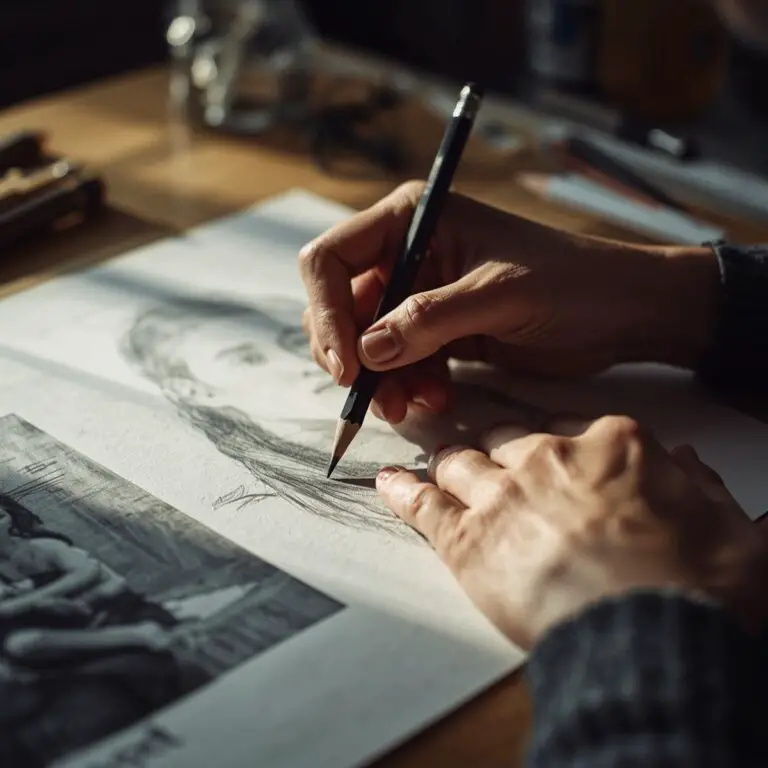
Another common mistake is relying on a single photo reference. Real life is three-dimensional and dynamic, but one photo only shows one angle, one lighting condition, and one moment. When you work from just one image, you’re forced to guess what’s happening outside the frame, which often results in awkward shapes and rigid forms. Using multiple references for the same subject—such as different angles of a torso, various lighting setups, or even anatomical diagrams—helps you understand the form more fully. This deeper understanding allows you to draw with confidence rather than hesitation, which naturally leads to more fluid and expressive lines.
Stiffness also comes from focusing on outlines instead of volumes. Beginners and intermediate artists often “draw what they see” by carefully tracing the edges of shapes, but strong drawings are built from masses, not contours. When you look at a photo, try to identify the big forms first: the ribcage as a box or barrel, the pelvis as a tilted block, the limbs as cylinders. Thinking in three dimensions helps you push and pull the form, exaggerate perspective, and create depth. Even subtle exaggeration can make a figure feel more alive than a perfectly accurate but flat copy.
Line quality plays a major role as well. When artists are unsure, they tend to use hesitant, scratchy lines or overly careful strokes. This uncertainty often comes from trying to match the photo exactly instead of committing to a drawing decision. Confident lines—even if they’re slightly inaccurate—create a sense of intention and movement. One way to practice this is to limit yourself to fewer lines or draw with a pen instead of a pencil. Removing the ability to endlessly correct forces you to prioritize flow and clarity over perfection.
It’s also important to remember that photos are not neutral. Lighting, camera angle, and lens choice dramatically affect how a subject looks. A wide-angle lens can distort proportions, while harsh lighting can create shadows that don’t clearly describe form. If you copy these effects blindly, your drawing may feel strange or uncomfortable. Instead, analyze the lighting and decide how you want to interpret it. Simplify shadows, clarify planes, and adjust values to better describe the form. You’re not obligated to reproduce every shadow exactly as it appears in the photo.
Stylization is another powerful antidote to stiffness. Even realistic art benefits from selective exaggeration. This doesn’t mean turning everything into a cartoon, but rather emphasizing what matters most. You might push the curve of a spine, enlarge a hand for expression, or simplify minor details that don’t serve the composition. Photos tend to treat everything with equal importance, but good art is selective. By deciding what to emphasize and what to downplay, you inject personality and intent into your work.
Studying from life whenever possible can also improve how you use photo references. Life drawing trains your eye to see depth, subtle shifts in posture, and natural variations that photos often hide. Even quick sketches from people in public or from your own hands can sharpen your observational skills. When you return to photo references, you’ll be better equipped to recognize what feels natural and what feels artificial.
Perhaps the most important mindset shift is understanding that reference is a guide, not a rule. Professional artists constantly modify, combine, and even ignore references when necessary. They use photos to answer specific questions—how a muscle overlaps, how fabric folds, how light behaves—then rely on their artistic judgment to assemble the final image. If something looks stiff, they don’t blame their skill level; they adjust the pose, push the gesture, or redraw the structure until it feels right.
In the end, avoiding stiffness is less about abandoning photo references and more about changing how you engage with them. When you observe instead of copy, simplify instead of trace, and interpret instead of replicate, your drawings gain flexibility and life. Photo references should support your creativity, not cage it. Used thoughtfully, they become a foundation for expressive, dynamic art rather than a source of rigidity.