
Sketching Architecture: How to Simplify Complex Buildings | Sketch Buildings For Beginners
Sketching architecture can feel intimidating, especially when you face a building covered in intricate details, unusual shapes, endless windows, or complicated perspectives. Many beginners assume that architectural drawing requires perfect precision, but the truth is that great architectural sketching is more about simplification than accuracy. The goal is not to copy every tiny element but to capture the essence, structure, and personality of the building. When you learn how to break architecture down into basic shapes, understand perspective, establish a clear hierarchy of detail, and focus on the forms that matter most, even the most complex buildings become approachable. Simplification is the backbone of expressive architectural sketching, allowing you to create drawings that feel both structured and alive.
The first principle of simplifying architecture is learning to identify basic shapes. Almost every building, no matter how complex, is made up of rectangles, cubes, cylinders, or triangular roof shapes. Gothic cathedrals, for example, look incredibly ornate, but the overall mass can be expressed as tall rectangular volumes with triangle-topped façades. Modern glass buildings might appear complex because of reflections and repetitive windows, yet the underlying form is often just a box or series of interlocking rectangles. When you begin a sketch, train your eye to ignore details and instead search for these large geometric shapes that define the structure. By outlining the major volumes before thinking about windows or decorations, you create a strong foundation that keeps the building accurate and prevents you from getting lost in small features too early.
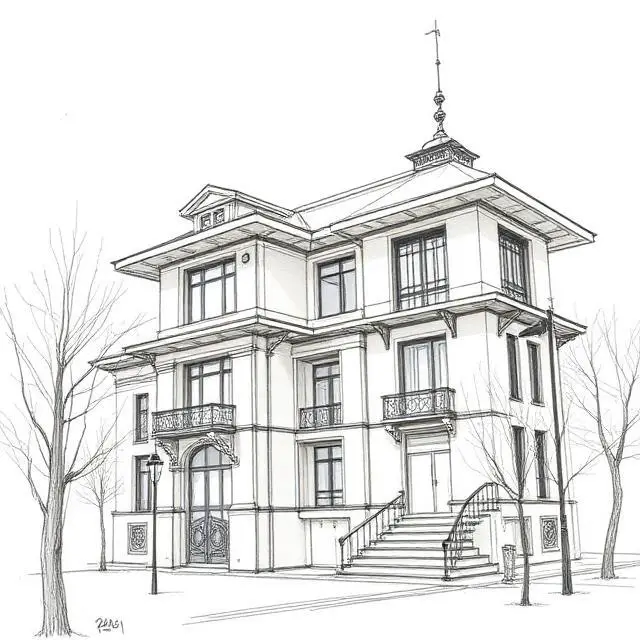
One of the most effective ways to simplify complexity is using the concept of visual hierarchy—deciding which details matter most and which can be ignored or suggested. Not every window needs to be drawn. Not every column needs full ornamentation. Instead, choose a focal point and emphasize that area more than the rest. If you’re sketching a historic building, maybe the entrance or tower is the most iconic element. If it’s a modern building, perhaps the dramatic angles or glass reflections are the focal point. Reduce detail as you move farther from that focal point, allowing the sketch to “fade out” gradually. This creates depth, directs the viewer’s eye, and keeps the drawing uncluttered. Suggesting detail by using light marks, broken lines, or simple shapes gives the illusion of complexity without overwhelming the composition.
Texture is another area where simplification becomes essential. Architectural textures—brick, stone, glass, wood, tile—can easily become repetitive and time-consuming. Instead of drawing every brick, use patterns sparingly to show material without covering the entire surface. Break brick areas into clusters, draw a few rows, and then imply the rest through shading. For windows, draw the main frames and indicate reflections with quick diagonal lines or shaded blocks. For stone, use irregular marks strategically placed around corners or shaded areas, not everywhere. Simplified textures keep your lines clean and help maintain focus on the major forms of the building. They also add visual interest without overwhelming the eye.
Lighting and shading also contribute significantly to simplification. Understanding light turns complicated architecture into readable shapes. Before adding shadows, ask yourself where the light is coming from and which surfaces are catching it. Shade only the planes that fall into shadow, and suddenly your building becomes three-dimensional with minimal effort. This simplifies the structure because clear value contrasts separate shapes better than excessive linework. Large cast shadows, such as those from roof overhangs or balconies, are especially useful in clarifying form. Even when working quickly outdoors, squinting your eyes can help identify the darkest areas to shade first, giving your sketch an instant sense of depth and volume.
Another strategy for simplifying architectural sketching is to work with line variety. Thin lines are perfect for structural outlines and distant elements, while thicker or darker lines can emphasize foreground details or important edges like door frames and rooflines. Varying your lines naturally creates a hierarchy without deliberate planning. When used purposefully, line weight can simplify a busy scene by making the important parts stand out. It also adds rhythm and movement to an otherwise rigid subject like architecture, giving your sketch personality and life.
When sketching on location, remember that speed often forces simplification—in a good way. You simply don’t have time to draw every detail, so you’re encouraged to focus on the essential structure. Urban sketchers often start with a loose gesture of the entire building to capture its posture and silhouette. A strong silhouette is often more impactful than perfectly rendered details. After capturing the gesture, they refine the sketch selectively, often leaving some parts loosely defined. Embracing imperfection is part of the charm of architectural sketching.
In the end, simplifying complex buildings is about learning to see the underlying order beneath the surface detail. It’s about choosing what to include rather than feeling obligated to draw everything. Architecture becomes accessible when you break it down into shapes, organize it with perspective, add clarity through light and shadow, and include details only where they matter. With practice, buildings that once seemed overwhelming become enjoyable subjects you can sketch confidently and expressively. Simplification isn’t about taking shortcuts—it’s about capturing the essence, structure, and personality of architecture in a way that feels natural, manageable, and uniquely your own.